To celebrate Black History Month, the Patriot League, on behalf of the League’s Anti-Racism Commission, spoke with Black leaders throughout the membership.
Black coaches, administrators and staff members around the League reflected on their respective journeys and shared stories that have shaped their identities.
Throughout February, those stories will be shared below in addition to on the League’s official X, formerly known as Twitter (@PatriotLeague), and Instagram (@patriotleague) accounts.
Chelsea France, Colgate University, Head Coach, Track & Field and Cross Country
As I reflect on my journey throughout my career, I think of all the individuals who paved the way for me to be in this position to lead and serve. Growing up in an environment where I was often the only or one of few persons of color, individuals who created safe spaces for me to grow and thrive were imperative in shaping my identity. The positive influence and support of family, coaches, and teachers who believed in me created a deeper belief and confidence in myself that can oftentimes be overshadowed by doubt and disparity.
I was blessed to have two amazing parents and a sister who stood by me while I navigated the challenges of being a black woman in a profession where many are not seen or progress in the field. My parents were two of the hardest-working individuals I have ever known. They instilled a work ethic and principles that required excellence in everything I pursued. Unknowingly, they were preparing me for the challenges they knew I would face as a Black student-athlete and now professional.
Sport was an equalizer throughout my adolescence and now adulthood. I fell in love with track and field because it is a sport where your individual marks are the evaluation of your success; it creates an even playing field that brings together people from all walks of life and different disciplines. Over the years, I have crossed paths with many coaches and mentors who shaped my experiences and paved the way. One of the most influential coaches I had the privilege to learn from was Coach Curtis Frye. Coach Frye was not only the first Black head coach at the University of South Carolina, he was the first coach to win a National Championship for the state of South Carolina. He was a coach who not only encouraged more diversity in the industry but also created opportunities and avenues for individuals to grow, and mentored many, including myself, to navigate the challenges one may face along the way.
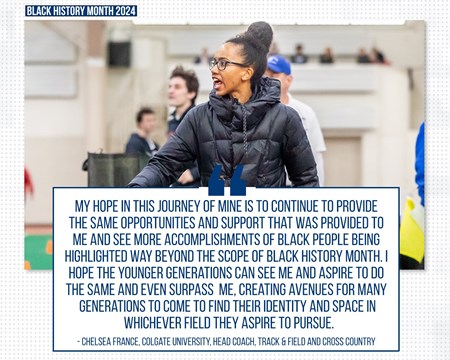
My hope in this journey of mine is to continue to provide the same opportunities and support that was provided to me and see more accomplishments of Black people being highlighted way beyond the scope of Black History Month. I hope the younger generations can see me and aspire to do the same and even surpass me, creating avenues for many generations to come to find their identity and space in whichever field they aspire to pursue. Black History Month is an opportunity for all of us to pay our respect to the black excellence of previous generations and many more generations to come.
Paige Corkins, College of the Holy Cross Women’s Basketball Assistant Coach
As a biracial woman growing up in New York, the diversity was immeasurable. Seeing people of all backgrounds shaped and made an impact on my life. Being surrounded by diversity seamlessly created social cohesion all around me.
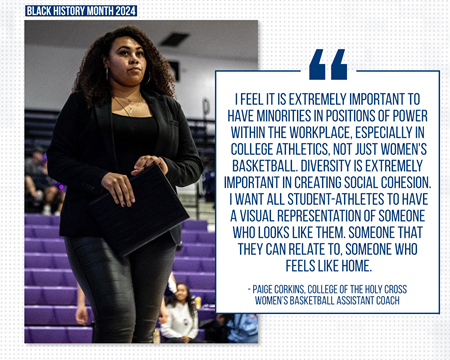
I feel it is extremely important to have minorities in positions of power within the workplace, especially in college athletics, not just women's basketball. Diversity is extremely important to create social cohesion. I want all student-athletes to have a visual representation of someone who looks like them. Someone that they can relate to, someone that feels like home.
Ganiyat Adeduntan, Colgate University Women’s Basketball Head Coach
I consider my journey unique because of my exposure to so many different things and people growing up. Starting with being Nigerian, African and Black. Born in Nigeria and moving to the United States at the age of five, and quite frankly taking a really long time to fit into the Black community where we first lived.
Fast forward to the game of basketball introducing me to a lot of different things, unique perspectives and a ton of experiences. I can’t imagine not having the game, which taught me so much, but belief in myself and confidence were at the top.
Then my education, being in the medical field; nursing. Watching my father excel in a white dominated field; medicine, specifically that in vascular surgery and the impact that had at times over the years not just on him, but our entire family.
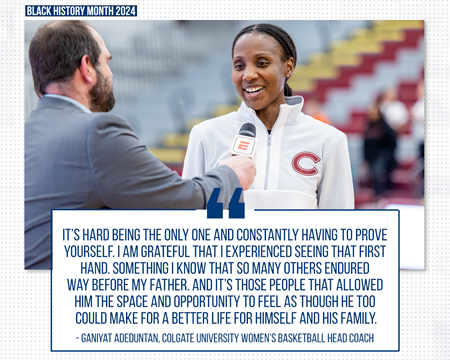
It’s hard being the only one and constantly having to prove yourself. I am grateful that I experienced seeing that first hand. Something I know that so many others endured way before my father. And it’s those people that allowed him the space and opportunity to feel as though he too could make for a better life for himself and his family.
I again think about choosing the medical field myself as my first profession. I strongly believe the best part of who I am is that, which is a nurse practitioner. Because of my training, holistic development, being the central part, the focus and the key foundation, which is to truly help develop and genuinely care for people not just by what you say, but by what you do.
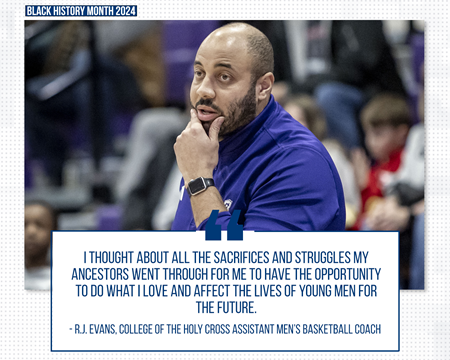
R.J. Evans, College of the Holy Cross Assistant Men’s Basketball Coach
In November, we visited the African American History Museum, and on the way out, I saw a quote that really impacted me. The quote was, “We Are the Hopes and Dreams of Every Slave.” It gave me a sense of gratitude and pride for being who I am in a world that doesn't always think that way about African Americans. I thought about all the sacrifices and struggles my ancestors went through for me to have the opportunity to do what I love and affect the lives of young men for the future.
Being an African American Coach, there are certain labels/stereotypes that you are associated with, and it has been that way my entire coaching career - "Good recruiter, can get close with players because they look like him, not great at on the floor coaching, X's and O's Weak in comparison to white coaches, not ready to run a program but a great asset on a staff". I fight these stereotypes every day and have been fortunate to play and work for African American Coaches who transcend this stereotype (Kevin Ollie and Shaka Smart). This drives me every day because one day, I hope my daughters grow up in a world where they will be judged on the merit of what they do and not how they look first - we have a long way to go with this in society but we are making strides.
Danielle O’Banion, Loyola University Maryland Women’s Basketball Head Coach
As I reflect on my journey, I am inspired by the many Black female coaches that came before me. This reflection also reminds me to strive to set a great example, as we never know who is watching.
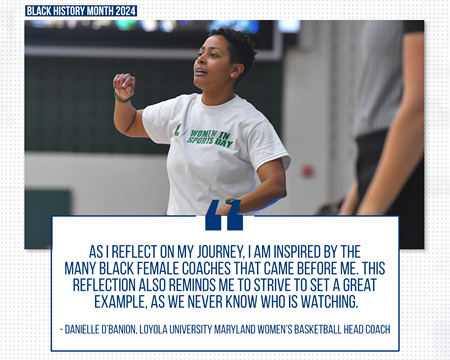
I knew I wanted to coach college basketball from an early age. This aspiration influenced my college decision. Ironically, I didn’t play for any Black coaches at Boston College. I LOVED my experience at BC and felt well-supported. However, as they say, representation matters. I was constantly watching opposing coaches (Vivian Stringer, Jolette Law, Carol Owens, Coquese Washington, Marianna Freeman and others) and their sideline demeanor and attire. They had no idea at the time that they were inspiring me and setting the standard for me.
Through the years, I’ve had the opportunity to share with these women the impact they continue to make on my life and career. My goal now is to try to pay it forward in every way.
Jermaine Truax, Bucknell University Vice President, Director of Athletics
Black History Month in the context of athletics represents a time of reflection and apperception for accomplished Black leaders in intercollegiate athletics like Gene Smith, Lee Reed, Ward Manuel, and Bernard Muir, who have shown that leadership transcends color and have proven to be some of the strongest Black leaders in the industry. They have paved the way and opened doors for young Black leaders like myself to have an opportunity for significant leadership roles in this space.
Throughout my journey, I have always understood the importance of being a strong Black leader who demonstrates that we are, in fact, capable of leading at the highest levels of collegiate athletics.
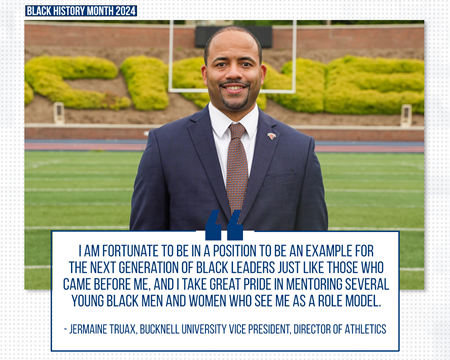
I am fortunate to be in a position to be an example for the next generation of Black leaders just like those who came before me, and I take great pride in mentoring several young Black men and women who see me as a role model.
Sherryta Freeman, Lafayette College Director of Athletics
As I reflect on my journey as a Black woman in sports, I believe EVERY experience along my journey has shaped me into the person I am today.
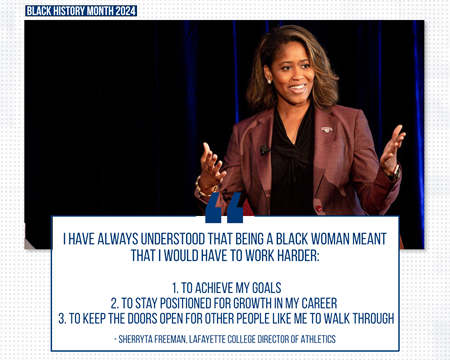
As early as I can remember, the power of education was instilled in me. I truly believe it opened the doors of opportunity for me and everything in my life. I have always understood that being a Black woman meant that I would have to work harder:
1. To achieve my goals,
2. To stay positioned for growth in my career and;
3. To keep the doors open for other people like me to walk through.
I am blessed beyond measure to be one of the very few Black women serving as a Director of Athletics at a Division I institution. Throughout my journey, I have lived by three words. Confidence. Courage. Champion.
I believe confidence comes with preparation; believing in yourself and your abilities because you have put in the work. Allow yourself to be confident but appreciate what you have to offer and deliver on that.
I know that things will not be easy; you will be tested, and life will always happen around you. There will be things you cannot control. You may even have people try to knock you down. Being courageous means that you persevere, you keep getting up, and you keep trying your best.
And lastly, be a champion. I mean, be a champion in everything you do. Approach everything with a winning mindset. And do the right thing even when no one is watching. That’s what champions are made of. And most importantly champions also champion others.
Camryn Crocker, Colgate University Assistant Men’s Basketball Coach
In the fall of 2015, I had the opportunity to attend a who's who coaching clinic called Coaching for Success Academy at Loyola Marymount University with John Calipari, Jay Wright, Dana Altman, and more. I was just getting my start coaching at the high school/grassroots level, so for me, this was the biggest deal. I was going to get the chance to learn from the highest-profile coaches in college basketball. Excited wasn't even the word. Little did I know that the information I'd learn would far exceed X's and O's.
Buzz Williams began his segment by asking about the Selma March of 1965. “Does anyone know why they were marching?”
“The right to vote! Those people were marching and were attacked for the ability to vote.” His message was that it is important to have an understanding of history and what others have gone through for us to live the lives we live.
Know your purpose.
Cuonzo Martin spent his time talking about his life journey. He spoke of the responsibility he felt he owed to all of his players to help them become strong men who will lead their lives in a positive way. Those were major wins. And he didn’t shy away from publicizing the responsibility he felt in helping young Black men. His ability to be authentic and vulnerable yet powerful and captivating pulled me in.
Serve others.
George Raveling, a basketball titan, who was the first African-American head coach in the Pac-8 Conference (now Pac-12), organized and opened the event. Every coach that followed him said they were there because he asked them to be. Even with that, Coach Raveling said that he was excited to learn from every person there, not just the coaches speaking. He was keeping an open mind to learn even after all he had accomplished.
Have perspective.
In my head, I thought, “Yes, I want to do this. I want to be able to educate and mentor through basketball. And I don’t have to sacrifice my identity to do this at a high level.”
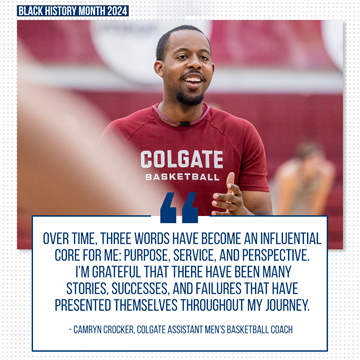
Over time, three words have become an influential core for me: purpose, service, and perspective. I’m grateful that there have been many stories, successes, and failures that have presented themselves throughout my journey. For me, it’s always important to remember who has come before me, who I’m currently trying to impact, and who will potentially follow. It’s all connected.
Mikajah Hayes, Patriot League Associate Director for Championships and Business Operations
Editor’s note: Hayes is in her second year at the League office after graduating from Boston University, where she competed as a member of the Terriers women’s track and field program.
My family is the primary reason that I am who I am today. Both my grandparents and parents instilled in me that education and hard work are essential to a successful life.
My grandfather studied physics in college and was later recruited by the CIA, where he worked for 35 years, facing discrimination and bigotry but relentlessly pursuing what he knew would provide a good life for his family. He never really spoke about the effect that his role had on his mental health. Still, we always knew that he worked hard to provide my father and uncle with opportunities that most African Americans did not receive during that time. Because of the sacrifices my grandparents made, my father was able to receive a quality education and garnered a love of learning that he passed on to me.
Growing up, both of my parents worked full-time jobs, which gave me and my siblings a sense of responsibility to learn to care for ourselves. We would get ready and go to school ourselves, walk home together, complete homework, and wait for our parents to get home before we were carted off to our extracurriculars. I have vivid memories of when both of my parents were laid off during the 2008 financial crisis. They never let their children's lives be affected by the financial issues they were dealing with. My parents made so many sacrifices so that we would never want for anything.
One person who I owe so much to and can never do enough to repay is my mother. My mother did not grow up with the opportunities that my father had. But her sheer will to provide a childhood to her children better than the one she experienced is one of the main reasons why my siblings and I are who we are. My mom forced me into the sport of track and field. I had been playing soccer, and she had seen the potential I had and researched teams in our area. I had refused to go to my first practice, and she dragged me there and told me how she knew I would be great if I just gave it a chance. I cried the whole drive there, but as the saying goes "a mother knows best."
Through that sport, I was able to receive a college education at one of the top universities in the country and found a career that I love. I can't thank my mom enough for pushing me in the right direction, even when I fought her the whole way.
All in all, my journey has shown me how the decisions one person makes can impact a future generation. The decisions my grandparents and parents made presented me with a future that not many are blessed to experience. The choices made by African American leaders in history made it so my grandfather could work for the CIA, so my parents could work at the companies they do, and so I could attend a school like Boston University.
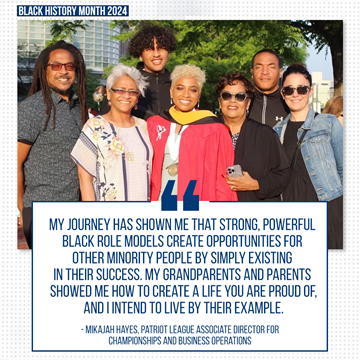
My grandfather's and father's choice to share their love of learning with me has allowed me to expand my knowledge past what is shared in a textbook and exists in a global community armed with tools to be successful there. My journey has shown me that strong, powerful Black role models create opportunities for other minority people by simply existing in their success. My grandparents and parents showed me how to create a life you are proud of, and I intend to live by their example.
Joe Jones, Boston University Men’s Basketball Head Coach
When I reflect back on my life as a Black American in the United States, I think the first person that comes to my mind is my Dad—and really watching and observing his life and his journey as a youngster and how that impacted my life.
My Dad was someone who was a really hard worker and took great pride in everything that he did. And that was an important lesson he taught me. He told us at a very young age, me and my two brothers, that being a Black American is not an easy thing. There will be people who will discount you, and there will be people who will pass judgment on you prior to ever meeting you, so you have to be great, and you have to be the best.
So, my Dad was a presser in a (dry) cleaner. It was a blue-collar job, six days a week, so I didn’t really see my Dad a lot as a youngster because he was out the door at 5:30-6 a.m. before we got up, and then he was coming home at 6 and 7 o’clock at night, and then we were going to bed early at a young age, so we spent time with him on the weekends. He worked on Saturdays but would usually get home around 5 or 6, then he would spend time with us, but he also spent time around the house. On Sundays, he would have other jobs where he would go clean offices and clean carpets and deliver and pick up clothes for people as well, so he was a really busy guy.
I watched the work ethic. I watched the pride that he took when I went to work with him that he put into his work. And then all of the lessons about the importance of working hard and being the best and understanding that things aren’t going to be easy, that you’re going to have to get over tough times and watching him and what he did.
The other person who had a lot of impact on my growing up was my varsity basketball coach when I was a junior. A guy by the name of Warren Isaacs. He was a 6 (foot)-8 (inch) brother, he was a guidance counselor and he was a basketball coach. And I loved him. I spent a ton of time with him. He was a single guy at the time, so he had a lot of time for me, so we would go and play pick-up basketball, and he would take me to restaurants to eat. I was kind of like his adopted son for a couple of years.
I kind of watched him in school. It was a predominantly white school that I went to, and Coach Isaacs was great with all of the kids. He made everyone feel comfortable; he was extremely friendly, he was kind of a connector. He was able to cross lines and racial barriers with the students. Everyone loved him and respected him, and I think that really played a part in my thinking of what I wanted to do.
So, lo and behold, I went through undergraduate, I went to graduate school and I became a guidance counselor and I became first a middle school coach, a JV coach and a varsity coach. I think that had a huge impact on my life just playing for Coach Isaacs and what he did for young people.
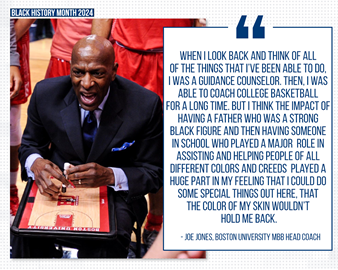
When I look back and think of all of the things that I’ve been able to do, I was a guidance counselor. Then, I was able to coach college basketball for a long time. But I think the impact of having a Father who was a strong Black figure and then having someone in school who played a major role in assisting and helping people of all different colors and creeds played a huge part in my feeling that I could do some special things out here, that the color of my skin wouldn’t hold me back. And I think I’ve taken that from both of these great mentors, my Dad and my high school coach, and tried to put that forth, and hopefully, I’ve impacted the next generation.